Mesäplltxevi, mesì’eyng    Two comments, two responses

Kaltxì, ma frapo!

The projects I’ve been working on seem to have slowed down a bit, at least temporarily, which provides more time for me to get to my big backlog of Na’vi contributions and comments. For right now, let me say a few things about two recent comments that I thought might be of general interest.

The first concerns Varang’s line to her warriors, ’Ur fkivan tstew! ‘Do not show fear!’ which I discussed last time. As I mentioned, ’ur is a noun having to do with how something comes across to you—the sight, look, or appearance of someone or something. So this brief sentence is an idiomatic way of saying, “Let your appearance look brave.” However, Zángtsuva pointed out that tstew ‘brave’ is an adjective marked “for people.” The corresponding word for things is tìtstewnga’. Since ’ur is a quality or thing, not a person, why isn’t the sentence ’Ur fkivan tìtstewnga’?

Good question. In fact, the version with tìtstewnga’ is grammatically correct. However, in the context in which Varang speaks it, the original version is justified, even if it bends the rules. She wants to say something sharp and punchy, with good rhythm. ’Ur fkivan tstew! is much stronger than ’Ur fkivan tìtstewnga’. And it’s perfectly understandable.

More than that, however, the distinction between words that are ofp—only for people—and those that are nfp—not for people—can blur and change over time. The example that always comes to my mind is English healthy vs. healthful. (I see I first mentioned this in an October 2014 blog post.) When I was in school all those many years ago, I remember being taught that healthy is for living things that can experience good health. I am healthy, my son is healthy, my cat is healthy, this tree is healthy. Healthful refers to something that provides good health: healthful food, healthful exercise, a healthful mental attitude. There’s a clear distinction! Saying “These tomatoes are very healthy” only makes sense if you’re talking about tomatoes on the vine in your backyard that are growing beautifully.

Well, that distinction seems to be ancient history. “Healthful” is rarely used now, and people have no problem saying, “This restaurant serves healthy food,” not realizing that this way of speaking was once frowned upon. Language changes! So it’s not out of the question to think that tstew in Na’vi might be evolving in a similar direction, where the ofp form widens its scope and the formerly nfp form is used less and less often.

The other comment I wanted to address concerns sru, the adposition I introduced last time which means a particular kind of ‘through.’ Is it legitimate to have a Na’vi word that sounds close to a word in an Earth language that means the same thing?

I’d divide this question into two components. First, how close, really, are through [θɹu] and sru [sɾu ]? When you transcribe their pronunciations in IPA, you see only one phoneme in the two words, the vowel, that’s identical. The others—the initial consonant and the r-like one—are not. It’s certainly true that the common [s] sound and the much rarer [θ] one are phonetically similar, with [θ] sometimes replaced by [s]. For example, when Persian borrows Arabic words, the letter representing the [θ] sound in standard Arabic, ث , is always pronounced [s] in Persian. And as Plumps pointed out, you hear that substitution as well in strongly German-accented English. (I may have referenced this before, but there’s an old TV commercial for the Berlitz language school that I’ve always loved. I find its humor gentle and delightful, and I hope no one will be offended.)

That said, for most English speakers, [s] and [θ] are totally different phonemes, and think and sink are just as different from each other psychologically as are link and pink. I have to confess that when I was first considering sru, it didn’t even occur to me it might be too close in sound to through. 🙂

But there’s a more general question here: Does it ever happen that two words in completely unrelated languages are very similar, or even identical, and mean the same thing? Well, yes. Irayo to Yätù’aw for the information about the Australian language in which “dog” is dog! The example I myself always think of is mahi. In Persian, it means ‘fish.’ In Hawaiian, mahi-mahi is a certain kind of fish. Persian and Hawaiian are completely unrelated. Cue the Twilight Zone music? Nope. It’s a coincidence.

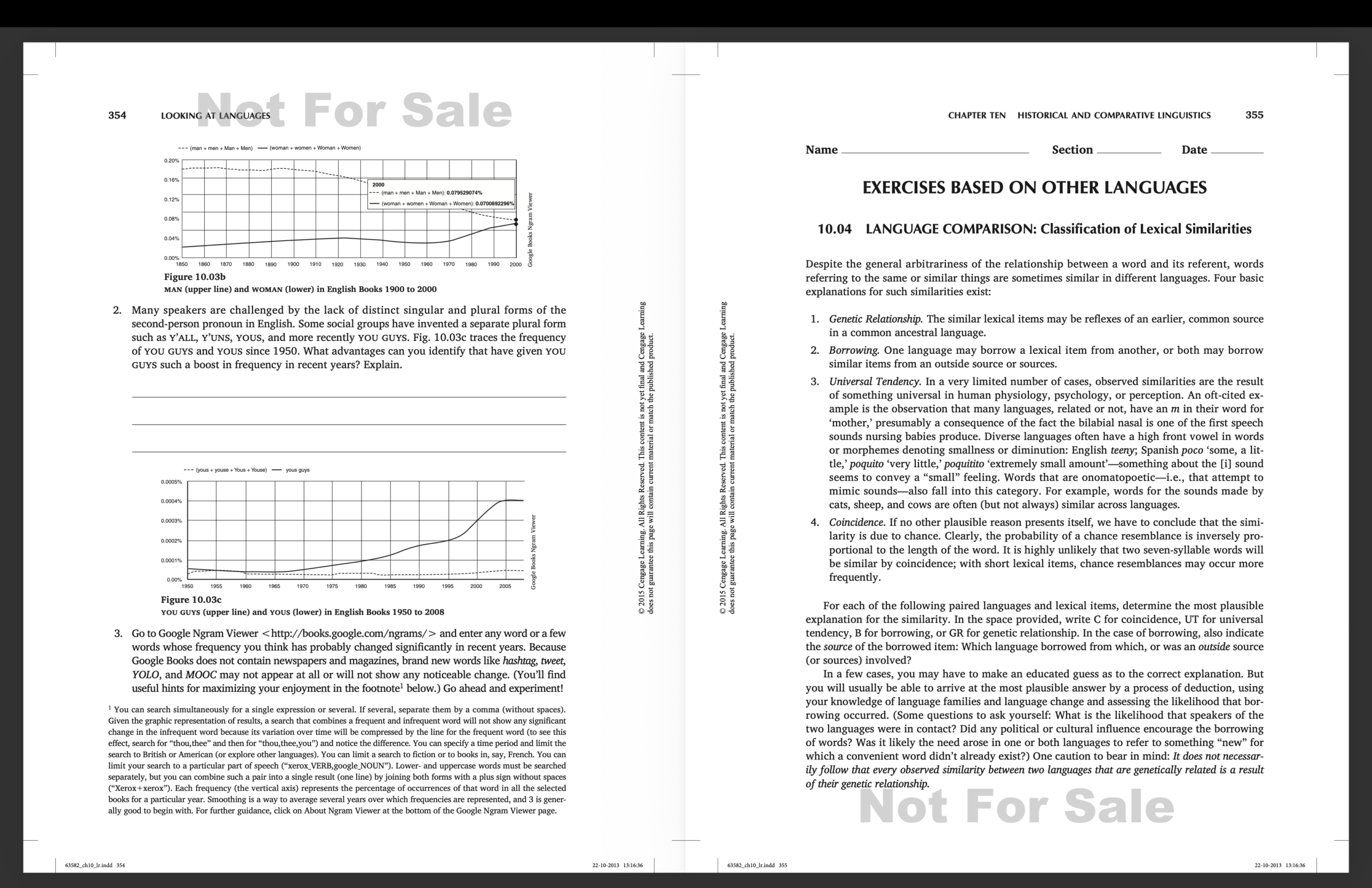
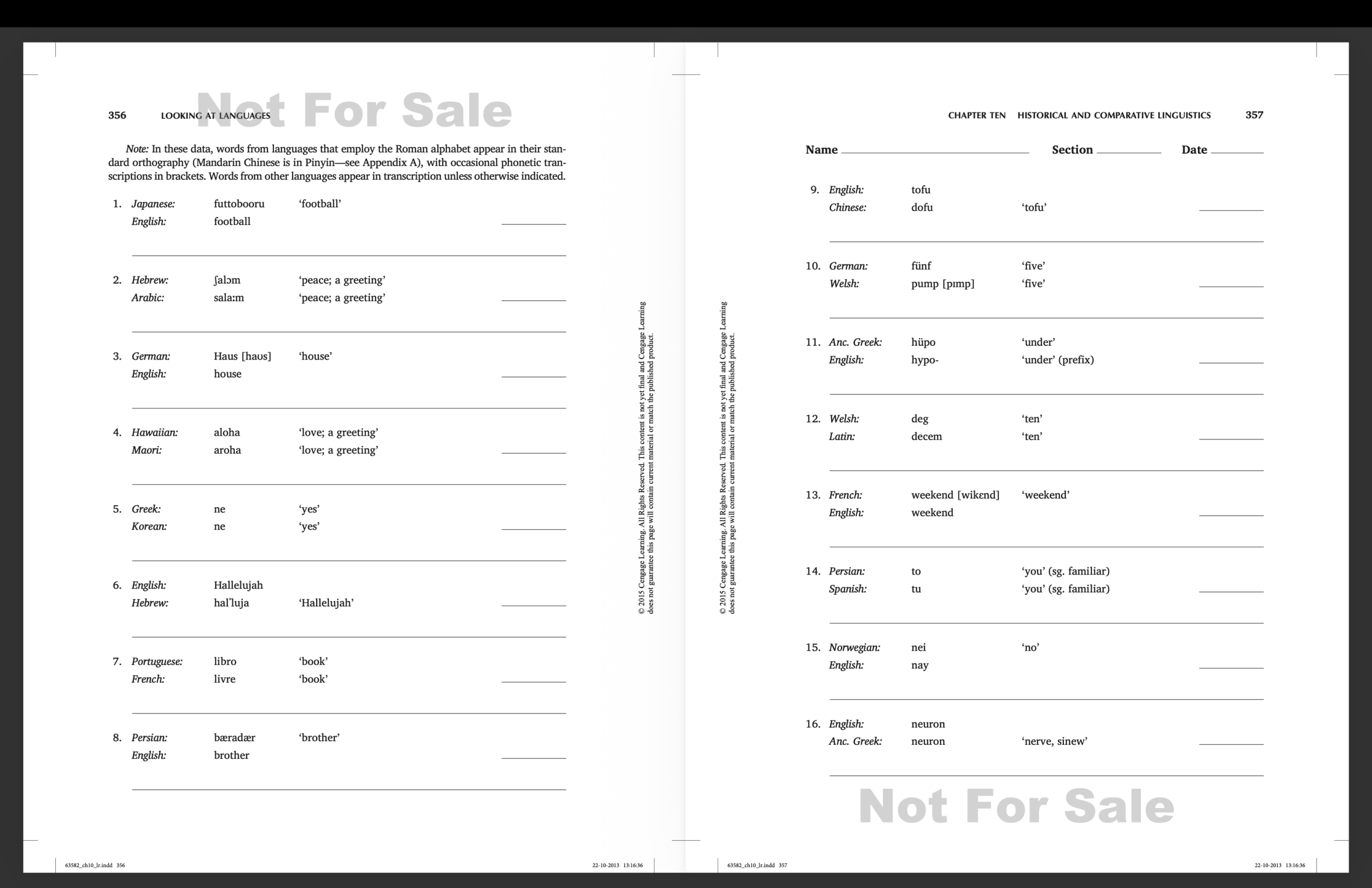
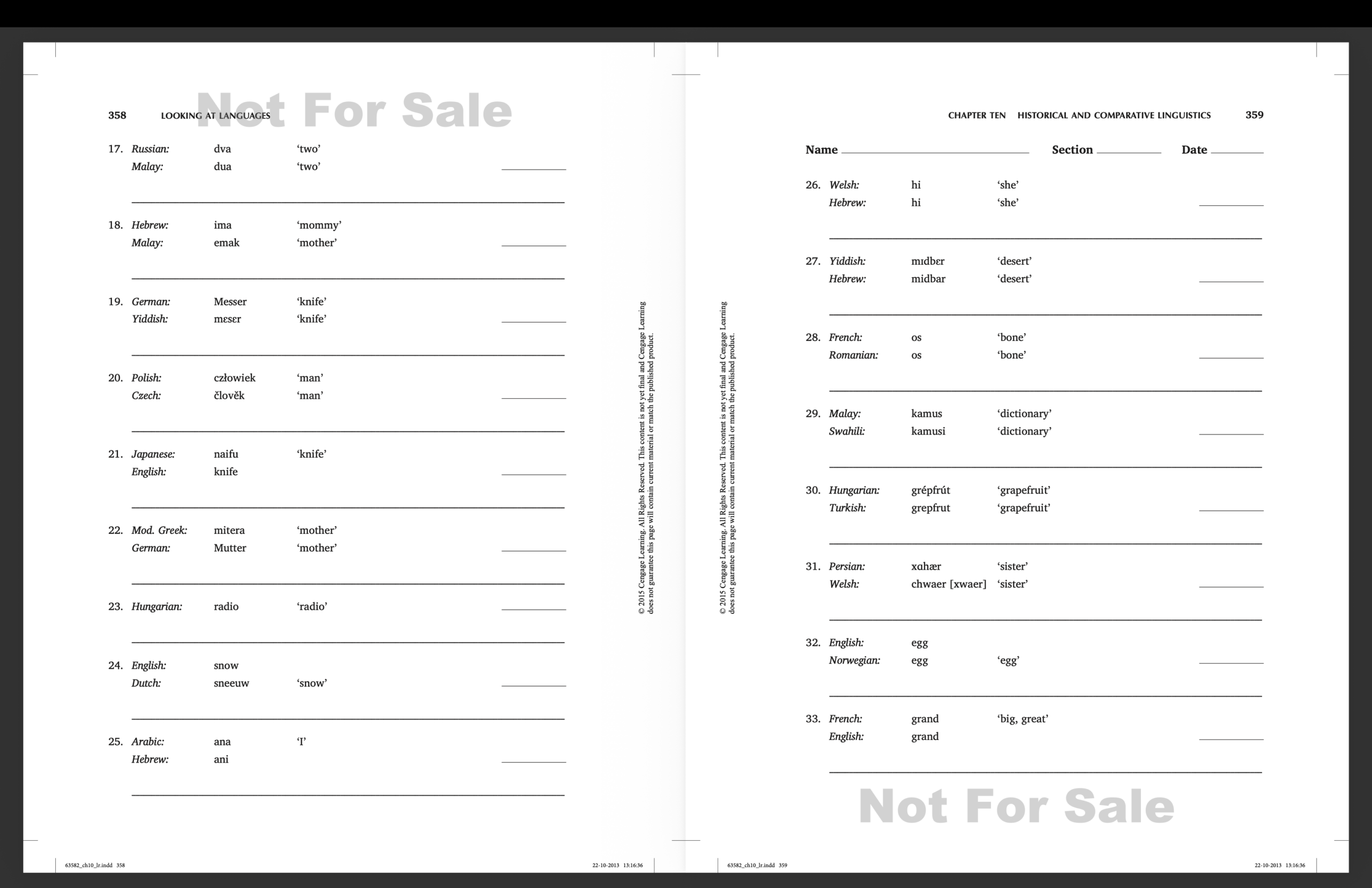
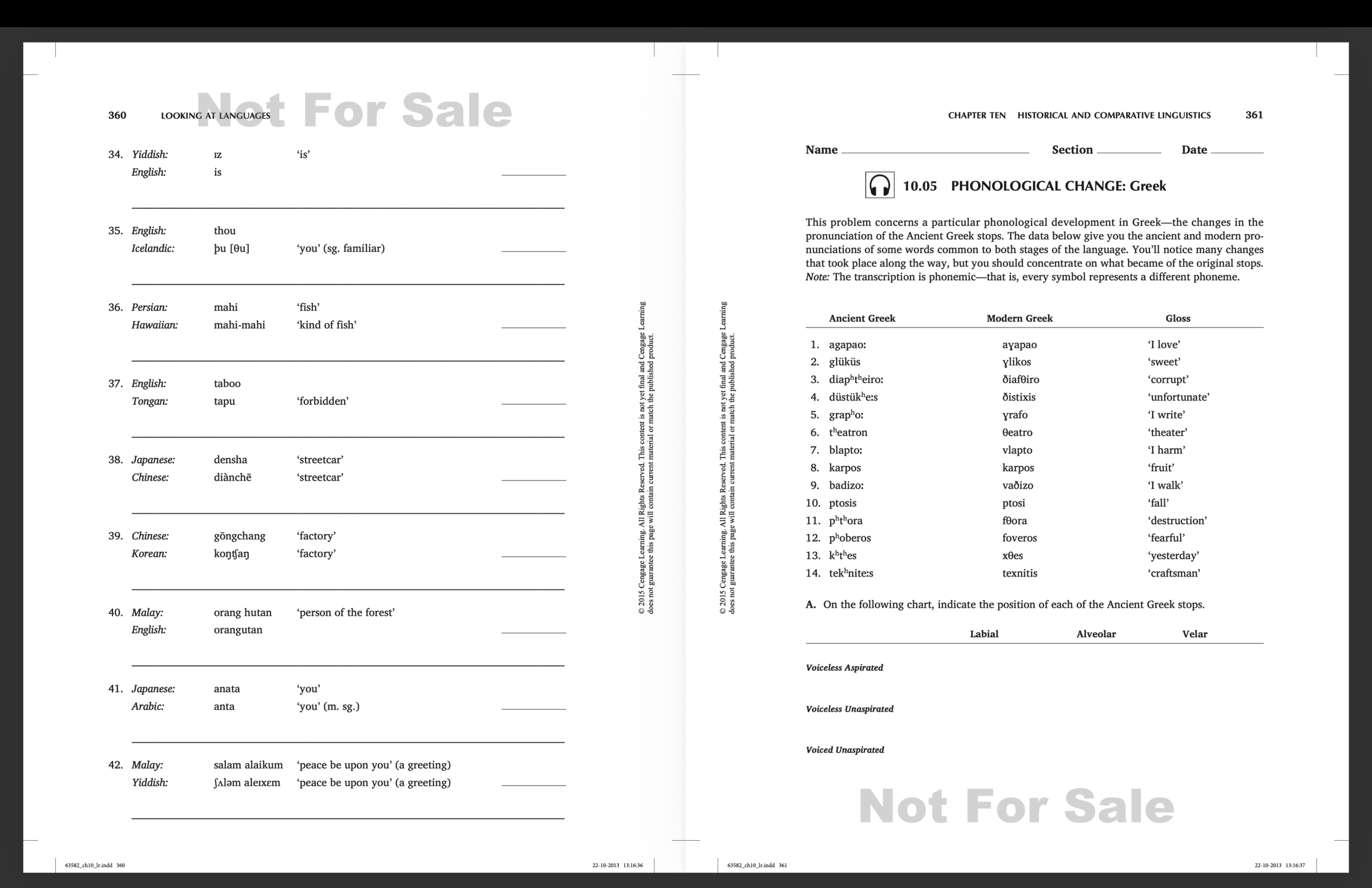
I thought I’d share this exercise with you from the linguistics workbook I wrote years ago with Edward Finegan, Looking at Languages. The idea is for students to look at similarities in different languages and decide how to explain them. Are the languages related, so that you would expect to see lots of similar things? Did one language borrow from the other? Could there be some universal tendency involved? Or is the similarity merely a coincidence? If you’re interested and you have some time, take a look! Make sure to read the introduction first. I’ve included the answer key, but don’t be tempted to check it until you’ve completed the whole exercise. Have fun!

Introduction

Items 1 – 16

Items 17 – 33

Items 34 – 42

Answers

1. B Japanese borrowed from English. 2. GR 3. GR 4. GR 5. C 6. B English borrowed from Hebrew. 7. GR 8. GR 9. B English borrowed from Chinese. 10. GR 11. B English borrowed from Greek. 12. GR 13. B French borrowed from English. 14. GR 15. B English borrowed from the ancestor of Norwegian. 16. B English borrowed from Greek. 17. C 18. UT 19. GR 20. GR 21. B Japanese borrowed from English. 22. GR 23. B Both borrowed from a third source. 24. GR 25. GR 26. C 27. B Yiddish borrowed from Hebrew. 28. GR 29. B Both borrowed from a third source (Arabic). 30. B Both borrowed from English. 31. GR 32. B English borrowed from the ancestor of Norwegian. 33. B English borrowed from French. 34. GR 35. GR 36. C 37. B English borrowed from Tongan. 38. B Japanese borrowed from Chinese. 39. B Korean borrowed from Chinese. 40. B English borrowed from Malay 41. C 42. B/GR Malay borrowed from Arabic, Yiddish borrowed from Hebrew. Hebrew and Arabic are genetically related.

Hayalovay!

ta P.

Posted in General | 16 Comments

Way Tìlalimä  The Windtrader Song

Ma eylan,

Ayngeyä kosmana aysäplltxeviri a teri tsapostì oeyä, seiyi irayo nìtxan! I always look forward to the useful and thought-provoking comments I get from the lì’fyaolo’. Thanks to everyone who wrote!

I’ll get to all those comments as soon as I can (including the ones from November!). But for right now, let me address Eana Unil’s question about the Tìlalim song, since I had forgotten to include that in the post.

Only one line of the song made it into the final cut of the film, and as often happens, that line underwent several transformations until it reached the form we all heard in Txep sì Txeva.

Here’s the recording:


And here are the words:

Txong hufwesru ’ulte, ulte ’efu nitram tawka.
‘The ship glides in the wind, and (we) feel happy across the sky.’

As you see, there are some new lexical items here.

txong (n.) ‘Windtrader airship’

sru (adp.+) ‘through’

Sru and kxamlä both mean ‘through’ and can sometimes be used interchangeably. But sru has the special connotation of moving inside and through a continuous substance, whether it’s water, air, or gel. So regarding the proverbial expression na kenten mì kumpay, ‘like a fan lizard in gel,’ i.e., being in an environment where you’re prevented from doing what’s natural to you, we could simply say,

Ke tsun kenten tswivayon sru kumpay.
’A fan lizard can’t fly through gel.’

To help you further distinguish these two adpositions:

    • Walking through the forest: better to use kxamlä. A forest is not a continuous substance.
    • A ship sailing through the water: better to use kxamlä. The ship is on the surface of the water, not inside it.
    • Swimming under water: better to use sru. You’re swimming inside and through a continuous substance.
    • A knife cutting through butter: better to use sru.
    • A yerik running through the grass: Debatable! Grass is not actually a continuous substance since it’s made up of individual stalks, but it can sometimes seem like an ocean. Either kxamlä or sru can be used here.

And finally:

’ulte (vin., ’ul.TE) ‘glide’

So there’s nice wordplay here with ’ulte followed by ulte.

Hayalovay!

Posted in General | 20 Comments

Follow-up to Txep sì Txeva

Kaltxì, ma eylan!

As I’m writing this, it’s still January here in California, so perhaps it’s not out of the question to wish you all a very belated Mipa Zìsìt Lefpom. I wish I could say 2026 has gotten off to a great start, but for many reasons, that’s clearly not the case. Let’s hope things improve significantly on all levels as we move forward into the year.

I assume everyone has seen Uniltìrantokx: Txep sì Txeva by now so that I don’t have to say “spoiler alert” in talking about it. But just in case you haven’t yet seen it, you might want to postpone this post until you do.

As you’ve discovered, there’s not a lot of Na’vi in A3. We don’t hear Ash People speaking very much in the language, and when they do, there’s no new dialect to be examined. When I asked JC back in 2017 about the kind of language Varang would speak, he explained that she would sound like the Omatikaya, which makes sense given her history.

That being said, there is some Na’vi in A3 that I hope attracted your attention!

First, there’s Varang’s lines to the Ash warriors:

Kllkxem kiven! ’Ur fkivan tstew!
‘Stand up straight! Do not show fear!’

I discussed Kllkxem kiven in last November’s blog post, although at the time I didn’t mention it was actually a line from the movie. 🙂

As for ’Ur fkivan tstew, fkivan, as you know, is from fkan, which means something like “come to the senses as” and is used in a basic “middle voice” paradigm. We’ve had examples like:

Nikreri Riniyä ’ur fkan lor.
‘Rini’s hair looks beautiful.’

’Ur is a noun glossed as ‘sight, look, appearance.’ A literal but very clumsy English translation of ’Ur fkivan tstew! would be, “May your appearance come to the senses as brave!” A normal, idiomatic translation would simply be, “Look brave!”

There’s also Varang’s chanting:

Txep payalon, payalon txep!
‘The fire will burn!

Payalon, of course, is the future of palon [PA.lon] ‘burn (vin., not vtr.)’. What’s interesting here is that Varang put the stress on the first syllable: PA.ya.lon, not on the second one, pa.YA.lon, as would be expected. It occurred to me that this might be the result of a small dialectal difference between Forest and Ash Na’vi. As you know, in FN, verbs with infixes always retain stress on the originally stressed vowel of the root: PA.lon vs. pa.YA.lon, since the A in palon is stressed. But the rule might be different in AN: infixed forms keep the stress on the same syllable as the one that’s stressed in the root: PA.lon vs. PA.ya.lon. If there’s a need to develop AN in the future, I’ll consider that possibility.

The more extended piece of Na’vi was the Jake-Quaritch conversation. Jake mentions kame to Quaritch, who responds testily:

Lì’uti oel omum.
‘I know the word.’

Then Jake says:

Ha nume fte kivame! Täpare hu ’uo a ngato lu nawm—’uo a nawm frato mì sìrey.
‘Then learn to See! Connect to something greater than you—greater than anything you’ve ever known.’

I hope that was understandable when you watched the movie!

One question I asked myself when I was thinking about Quaritch’s terse response to Jake is whether omum is the best verb to use when you want to say you know a word. We’ve certainly had precedent for it, as in this sentence from a 2013 blog post:

Pol ke tslam stum ke’ut, omum lì’ut avol nì’aw.
‘He understands almost nothing and only knows eight words.’

So omum used in this sense is perfectly grammatical. But there’s another way to express the idea:

Tsalì’u smon oeru.
‘I’m acquainted with that word.’ OR ‘That word is familiar to me.’

As most of you know, many languages insist on this difference. In French, for example, ‘I know that word’ is Je connais ce mot, where the verb connais means ‘am acquainted with.’ Saying this with the verb for knowing a fact, *Je sais ce mot, is ungrammatical. (French speakers: Let me know if you don’t agree with that!) But in Na’vi, both forms are acceptable.

It occurred to me, however, that there might be a subtle difference between (1) Oel omum tsalì’ut and (2) Tsalì’u smon oer. (2) could merely state you’re familiar with the word, in the sense that you’ve heard it before, while (1) implies you have a deeper understanding of the word’s meaning.

In any event, Quaritch, with his developing but still imperfect Na’vi, would more likely know omum than smon, so I think his response was appropriate.

I have a lot of proposals from the LEP for new vocabulary to consider, which have been sitting and aging on my desk. I’ll get this post out now and then turn to those next. As I often have to say, thank you all so much for your patience.

Hayalovay!

ta P.

Posted in General | 11 Comments

Poläheiem “Txep sì Txeva”!    “Fire and Ash” has arrived!

Kaltxì, ma eylan!

As many of you know, the world premiere of Uniltìrantokx: Txep sì Txeva took place Monday night, December 1st, here in Hollywood. It was, as expected, an exciting and gala event. I won’t say much about the movie, since you’re still waiting to see it, but I can tell you that if you loved A2, you’re going to love A3 just as much or even more.

For now, let me share some images from the premiere.

Here’s a little video to show you what we were greeted with in the gathering place before we entered the Dolby Theater. It was impressive!

Flaming Avatar A

Guess who:

Here’s how the screen looked inside the theater as people took their seats:

James Cameron was there to introduce the film and the major actors. You probably recognize all of these people.

Responses to the comments on the previous post are coming . . .

Hayalovay!

Posted in General | 8 Comments

Kaltxì nìmun! Hello again!

Ma eylan,

Tse . . . kezemplltxe, txankrr oel ke tolok fìtsenget. I’ve been busy with things professional and personal that have kept me away, but I’m glad to be back in touch with you all, especially now that excitement is building for the advent of Txep sì Txeva. (See below!)

Before I get to the new vocabulary, let me mention a couple of things I’ve been doing, or will do soon, that I’d like to share with you.

First, a few days ago I attended a book-launching event for Jon Landau’s posthumous memoir, The Bigger Picture: My Blockbuster Life & Lessons Learned Along the Way.

It was a big gathering in a private section of an upscale Japanese restaurant here in Los Angeles, and very well attended. People spoke movingly about Jon, both in person and on video. James Cameron was there, along with Jon’s wife and sons. I had the chance to talk with some Avatar people I hadn’t seen in a while, including the composer Simon Franglen and the actor Joel David Moore, who of course played Norm Spellman. It was a wonderful and uplifting evening.

Also related to Avatar, I completed a little project that you might get a kick out of, once the Blu-ray disc of A3 becomes available. I’ll leave it at that for now. 😉

And for the third time, I’ll have the privilege of attending an Avatar opening. Fire and Ash premieres on Monday, December 1, here in Hollywood. I can’t wait!

OK, on to the new words and expressions. A few of these were LEP submissions—irayo nìfrakrr! And who knows—perhaps some of them might be useful to keep in mind as you’re watching A3. 🙂

txeva (n., TXE.va) ‘ash’

As you know, we already have the word txepìva meaning ‘ash (of a fire.)’ Txeva is a shortened form of the word known to all the clans but used especially by the Ash People.

And so, Avatar: Fire and Ash is, in Na’vi, Uniltìrantokx: Txep sì Txeva.

Speaking of the new clans you’ll encounter in A3, you’ve doubtless heard of the Mangkwan (Ash People) and the Tlalim (Windtraders). These names have already appeared in the media. I suspect you’ve noticed they do not obey the standard rules of Na’vi word formation. The explanation is that these spellings represent how the names are colloquially pronounced. Mangkwan “should be” Mangkuan, and Tlalim “should be” Tìlalim. But the forms in standard spelling have three syllables (Mang.ku.an, Tì.la.lim), while in colloquial pronunciation they only have two. If you’re composing a text in Na’vi and you want to include these clan names, you can choose between the nonstandard colloquial spellings or the standard ones—it’s up to you.

keri (adj., KE.ri) ‘fierce’

Keri can be used either for people (tsamsiyu akeri ‘fierce warrior’) or things (aylì’u akeri ‘fierce words’). As an example of this latter use, note this proverb in the form of a short poem:

Aylì’u akeri
Lekxu to tìtseri.
’Fierce words can be more harmful than you think.’

This has been shortened from the full form of the expression, Aylì’u akeri tsun lekxu livu nì’ul to tìtseri, which, while perhaps clearer, isn’t nearly as memorable. Recall the idiom to tìtseri ‘than is apparent, than you are aware of.’

lekxu (adj., le.KXU) ‘harmful’

fleyul (n., FLEY.ul) ‘falsehood, falsity’

The expected word for this concept, tìtsleng, is also possible:

tìtsleng (n., tì.TSLENG) ‘falsehood, falsity’

But fleyul is more commonly used.

Fleyul aylì’uä peyä law slolu frapor.
‘The falsity of his words became clear to everyone.’

Fleyulìl pot skola’a.
‘Falsehood destroyed her.’

palate (vin., pa.LA.te, inf. 2,3) ‘crumble, fall apart, disintegrate’

Tsanivi atxawnula nìfe’ hufwemì palolate.
‘That poorly constructed hammock fell apart in the wind.’

kxew (intj.) ‘expression of disappointment or frustration when things don’t go as planned’

This useful word is used like the English expressions Nuts! Darn! Damn!

Kxew! Oey tsko tsìlmawng!
‘Damn! My bow just broke into pieces!’

fpal (vtr.) ‘honor or fulfill a commitment or undertaking’

Oey fänut oel fpal frakrr.
‘I always keep my promises.’

Ngal kea tsonit ke fpal kawkrr!
‘You never fulfill your obligations!’

uturtu (n., u.TUR.tu) ‘refugee, person in need of uturu

Zene awnga fayuturtur srung sivi.
‘We must help these refugees.’

kakzir (adj., kak.ZIR) ‘numb’

Compare this word to the other kak– words we’ve had relating to the lack of certain senses—kakrel ‘blind,’ kakpam ‘deaf,’ kakmokri ‘mute.’

Pori pxun kakzir latsu.
‘His arm must be/appears to be numb.’

Kakzir can also be used metaphorically to mean “emotionally numb,” as if your emotions were turned off just like physical numbness.

Teri kxitx peyä stawm a krr, oe kakzir slolu nìwotx.
‘When I heard about her death, I became completely numb.’

tìkakzir (n., tì.kak.ZIR) ‘numbness’

And finally,

ken (vin.) ‘behave assertively and with confidence’

As you know, this verb has a homonym, namely the adposition ken meaning ‘despite, in spite of.’ Since the two kens are totally different parts of speech, there shouldn’t be confusion as to which one is meant.

Eyktan asìltsan, ken ayskxe mì te’lan, zene kiven frakrr.
‘A good leader, despite the stones in his heart, must always behave confidently.’

And note the following idiom:

Kllkxem kiven!
‘Stand up straight!’

The implication here is: stand up straight and proud, projecting a feeling of confidence.

That’s it for now. Hayalovay, ma eylan!

ta P.

P.S.: Irayo nìtxan to all those who contributed suggestions for revising the resource list. I haven’t gotten to that yet, but I will, and I appreciate all of your submissions.

Posted in General | 24 Comments

Revising the resource list

Kxì, ma frapo.

Vospxìvolaw lefpom! Happy September! And for those of you in the USA, Ftxozä Tìkangkemä prrte’ livu ayngar! Enjoy your Labor Day!

If you look over on the side of this page, you’ll see Na’vi on the ‘Net, a list of resources for Na’vi learners. As I don’t have to tell you, it hasn’t been updated in a very long time; in its current state, it’s incomplete and out of date. I’d like to remedy that situation.

So, for those of you who are interested, I’d like to solicit your help in making the revisions. Please let me know which of the listed resources are out of date or defunct and should be removed, but also, more importantly, which ones you’d like to see added. These can be resources created by other people that you’ve found valuable, or ones you’ve created yourself.

Rather than replying in the comments with your suggestions, please contact me privately via email. I think you all know my address: my-last-name AT marshall DOT usc DOT edu. And please use the subject line “Na’vi Resources” so I’ll be able to flag these emails immediately. Please also include a VERY BRIEF DESCRIPTION, no more than one sentence, of the online resource along with its URL, which I’ll try to include in the listing. (If you’d like to elaborate on your suggestions in your email to me, explaining why you feel they’re useful, that will of course be fine.) I’ll take all your suggestions into consideration as I revise the list. (As has been the case up to now, names of creators won’t be included in the Na’viteri listing, although they may well be available on the resource site itself.)

Please get your suggestions to me no later than Sunday, 14 September.

Irayo, ma eylan!

ta P.

Posted in General | Leave a comment

Ayu leketengsyon   Various things

Kxì, ma frapo! Hi all!

To start off the new month, here’s a bit of new vocabulary along with some conversational expressions I hope you’ll find useful. As usual, some but not all the new words are taken or adapted from recent LEP submissions.

sweri (vtr., SWE.ri, inf. 1,2) ‘praise’

Tarontswot peyä frapol sweri.
‘Everyone praises his hunting ability.’

Ngeyä nantangtsyìpit sweri krra lek aysäkxìmit!
‘Praise your dog when he follows (your) commands!’

Lesnonrra tute a swäperi frakrr slu eyktan afpxamo.
‘An arrogant individual who always praises himself makes a terrible leader.’

säkxìm (n., sä.KXÌM) ‘a command or order’

tìsweri (n., tì.SWE.ri) ‘praise (general sense)’

säsweri (n., sä.SWE.ri) ‘praise (instance of)’

tìswäper (n., tì.swä.PER) ‘self-praise’

As you might guess, tìswäper has a negative sense and overlaps with the idea of boasting.

lehangham (adj., le.HANG.ham) ‘laughable, ridiculous, absurd’

Keep in mind that the meanings of le- adjectives are not always predictable. Here, lehangham doesn’t mean ‘pertaining to laughter’ or ‘funny’ (that would be ’ipu) but rather something that makes you laugh derisively. It can be used to describe people as well as ideas and events.

fenge (vtr., FE.nge, inf. 1,2) ‘mock, ridicule’

Oeti fenge rä’ä!
’Don’t mock me!’

Folenge frapol peyä tìhawlit lehangham.
‘Everyone ridiculed his ridiculous plan.’

tìfenge (n., tì.FE.nge) ‘ridicule’

nìleyn (adv., nì.LEYN) ‘repeatedly’

nal (vin.) ‘suffer’

Nal can refer both to experiencing physical pain and to emotional suffering .

Krra tse’a oel tìfkeytokit txanlokxeyä oey, nal nìtxan mì te’lan.
‘When I see the condition of my country, I suffer greatly in my heart.’

nalsteng (vin., NAL.steng, inf. 1,1) ‘feel empathy or compassion’

This verb is a compound of nal + ’awsiteng ‘together.’ The idea is that when you feel empathy or compassion for someone, you are suffering together with them. (In fact, the English word “compassion” was derived in much the same way: the com– part goes back to the Latin word cum, meaning ‘with,’ while the passion part relates to suffering, as in the Christian notion of Christ’s passion on the cross.)

Pori oe nalsteng.
‘I feel compassion for him.’

Alternatively, we can use hu:

Pohu oe nalsteng.
‘I feel compassion for him.’

tìnalsteng (n., tì.NAL.steng) ‘compassion, empathy’

lenalsteng (adj. ofp, le.NAL.steng) ‘compassionate’

tìnalstenga’ (adj. nfp, tì.NAL.ste.nga’) ‘compassionate’

Finally, take a look at these idiomatic ways of saying that something or someone looks/sounds/tastes/smells good or bad. They’re more common in colloquial conversation than the related structures using fkan. The outline of the structure is:

SUBJECT + za’u + ADVERB + ne + [SENSE ORGAN]

Here are some examples that should clarify this usage:

Nga za’u nìltsan ne nari.
‘You look good.’
(Literally: You come well to the eye.)

Po za’u nìfe’ ne nari.
‘She looks bad.’

Fìsyuve za’u nìfe’ ne ftxì.
‘This food tastes bad.’
(Literally: ‘This food comes badly to the tongue.’)

Nga za’u nìfpxamo ne mikyun. Mokriri kempe lolen?
‘You sound terrible. What happened to your voice?’
(Literally: ‘You come terribly to the ear.’)

And a heads-up: As many of you know, the annual online Na’vigation conference takes place this weekend, Friday Aug. 1 through Sunday Aug. 3. It’s open to absolutely everyone who’s interested in the Na’vi language. You can watch the proceedings here. And the schedule of events is here.

Hayalovay, ma eylan!

Posted in General | 31 Comments

Vospìkin Lefpom!  Happy July!

Ma eylan,

Fìzìsìtìri, mawl a’awve solew, mawl amuve polähem.

To quote the beautiful song written by Sandy Denny and memorably sung by Judy Collins, who knows where the time goes?

In any event, July has arrived, and many of us are hoping the second half of 2025 will be better than the first. On that hopeful note, then, here are some new words to mark the occasion. The majority of these came directly from my backlog of submissions from the LEP Committee or were inspired by their suggestions.

ketengsyon (n., KE.teng.syon) ‘variety, diversity’

This is clearly a compound of keteng ‘different’ + syon ‘characteristic.’

leketengsyon (adj., le.KE.teng.syon) ‘diverse, various’

Plltxe Sawtute fa aylì’fya leketengsyon.
‘Humans speak diverse (OR: a variety of) languages.’

tengwotx (adj., TENG.wotx)  ‘uniform, non-diverse’

From teng ‘same’ + nìwotx ‘completely, all’ where the – prefix has dropped.

tìtengwotx (n., tì.TENG.wotx) ‘uniformity’

Nawnumtsengä aynumeyuri ley ayngaru tìtengwotx, ayoeru ketengsyon.
‘Regarding university students, you value uniformity, we value diversity.’

nawnumtseng (n., naw.NUM.tseng) ’university’

From nawm ’great, noble’ + numtseng ‘school.’ Notice that the -nm- combination has evolved simply to n.

kxapay (n., KXA.pay) ‘spit, saliva’

This is literally ‘mouth water.’

kxapay si (vin.) ‘salivate’

Note that this does not mean to spit deliberately. That would be:

kxapaytsre’ (vin., KXA.pay.tsre’, inf. 3,3) ‘spit’

This is from kxapay + tsre’i ‘throw.’

Fwa kxapaytsre’ lu txavä’.
‘Spitting is disgusting.’

zäfizal (n., ZÄ.fi.zal) ‘fired clay, ceramic material’

From zäfi ‘processed, cooked’ + zal ‘clay.’

Zal by itself can refer either to clay in its natural state or to baked clay; zäfizal is exclusively the latter.

Fìtsngalit fkol txula ta zäfizal.
‘This is a ceramic cup. OR This cup is made of fired clay/ceramic material.’

ketstun (adj., ke.TSTUN) ‘unkind, emotionally cold’

Here tstunwi ‘kind’ has contracted simply to tstun.

A proverbial expression:

Tute aketstun slivu ’eylan ke tsun.
’An unkind person cannot be a friend.’

tìktstun (n., tìk.TSTUN) ‘unkindness, emotional coldness’

spxintu (n. SPXIN.tu) ‘sick or ill person’

Längu zama spxintu mì sray oeyä.
‘I’m sorry to say there are sixty-four sick people in my village.’

räzekx (n., RÄ.zekx) ‘curse’

tìng räzekx (vin.) ‘to curse’

Räzekx is the opposite of syawn ‘blessing.’ Tìng räzekx is a strong way of wishing someone ill.

Oe ngaru tìng räzekx, ma kalweyaveng!
‘I curse you, (OR: Damn you!), you SOB.’

rayl (adj.) ‘feeling pity and sorrow for someone’s misfortune’

Pori sa’nok tìmerkup; ’efu oe rayl.
’His mother just died; I feel bad for him.’

To end on a positive note:

lornusrr (adj., LOR.nu.srr) ‘radiant’

From lor ‘beautiful’ + nrr ‘glow,’ in the active participle form with <us>.

Eyweveng lu lornusrr.
‘Pandora is radiant.’

Hayalovay, ma eylan!

Posted in General | 30 Comments

Mevosìnga lì’u amip     Twenty new words

Kaltxì, ma frapo! Sìlpey oe, ayngaru livu fpom nìwotx.

Here are about twenty new words and expressions that I hope you’ll find useful. The majority came directly from, or were inspired by, the recent submissions I received from the Lexical Expansion Project. Irayo, ma smuk! Seysonìltsan!

In no particular order:

kxäl (adj.) ‘apathetic, feeling of apathy’

Fìtìngäzìkìri ’efu po kxäl; pori tsa’u ke tsranten kaw’it.
‘She’s apathetic about this problem; it doesn’t matter to her at all.’

tìkxäl (n., tì.KXÄL) ‘apathy’

Tìkxäl lu peu? Lu tskxepay a mì te’lan sì kxitx a mì eltu.
‘What is apathy? It’s ice in the heart and a death in the brain.’
(This evocative example is from the LEP.)

nìkxäl (adv., nì.KXÄL) ‘apathetically’

lìlì (n., LÌ.lì) ‘breast’

hilu (n., HI.lu) ‘nipple’

wantseng (n., WAN.tseng) ‘hiding place (temporary)’

A wantseng is a temporary hiding place, where for example a prey animal might hide from a predator. It’s not used for a permanent refuge.

mu’nitkan (adj., MU’.nit.kan) ‘effective’

This word is derived from mu’ni ‘achieve’ and tìkan ‘goal, target.’ Something that’s effective reaches its target or achieves its goal.

Tsayerikìl mu’nitkana wantsengit rolun; ke tsun fko pot tsive’a kaw’it.
‘That hexapede has found an effective hiding place. He can’t be seen at all.’

(NOTE: Whether you refer to an animal as a “he/she” or an “it” depends on how you feel about it. In this example, however, using pot rather than tsat has a practical function: it avoids an ambiguity. If it were tsat, you wouldn’t know if it was the hexapede or the hiding place that couldn’t be seen!)

kemu’nitkan (adj., ke.MU’.nit.kan) ‘ineffective’

tìmu’nitkan (n., tì,MU’.nit.kan) ‘effectiveness’

nìmu’nitkan (adv., nì.MU’.nit.kan) ‘effectively’

(NOTE: “Effectively” means two different things in English: (1) ‘in such a way as to reach a target,’ and (2) actually rather than officially or explicitly, as in “His campaign is effectively over”—that is, it’s over for all practical purposes, even if its demise hasn’t yet been announced. Nìmu’nitkan only has the first meaning, not the second.)

txeylan (n., TXEY.lan) ‘best friend’

This word evolved from txe’lan ‘heart’ + ’eylan ‘friend.’ In Na’vi, your best friend is your “heart friend.”

napxì (adv., na.PXÌ) ‘partially, in part’

This adverb originally had the regular – prefix—i.e, *nìhapxì—but due to the stress pattern, where the first two syllables were unstressed, it evolved to its present irregular form.

Fìtìkangkemvi hasey lu napxì nì’aw.
‘This project is only partially complete.’

tsup (n.) ‘chasm, ravine’

This yields the proverbial expression:

Rä’ä zup nemfa tsup.
‘Don’t fall into the chasm.’ (That is, don’t fall into the trap that someone has laid for you.)

wätum (n., WÄ.tum) ‘antidote’

As you can tell, this comes from ‘against’ + txum ‘poison.’ (Recall that is one of those adpositions that trigger lenition.)

Peyä aylì’uri atxumnga’ wätumìl pesenget?
‘Where is the antidote for his poisonous words?’

mewn (vin.) ‘sigh’

Nga merewn pelun, ma paskalin?
‘Why are you sighing, sweetie?’

sämewn (n., sä.MEWN) ‘sigh, an instance of sighing’

Zola’u ftu käpxì numtsengviyä sämewn awok.
‘From the back of the classroom came a loud sigh.’

tì’ewan (n., tì.’E.wan) ‘youth (time of life)’

tìkoak (n., tì.KO.ak) ‘old age’

A proverbial expression:

Nìwin ’ìp tì’ewan, nìwin pähem tìkoak.
‘Youth vanishes quickly, old age arrives quickly.’

kxal (adj.) ‘strict, demanding proper behavior’

This word refers to someone who’s a strict disciplinarian or a “stickler for the rules.”

Another proverbial expression:

Ftumfa kxala karyuä kxa za’u sänume a ley.
‘From the mouth of a strict teacher comes valuable instruction.’

tìkxal (n., tì.KXAL) ‘strictness, discipline’

And yet another proverb:

Tìkxalìl tìkxälit zeyko.
‘Discipline cures apathy.’

Finally, some new uses of a couple of familiar words:

As you know, the terms for ‘ascend’ and ‘descend’ are fäkä and kllkä respectively. When accompanied by the adpositions sìn ‘onto’ and ftu ‘from,’ they’re also the terms for getting on or off a vehicle or conveyance. When used with an animal, they mean ‘mount’ or ‘dismount.’

fäkä sìn (v.) ‘get on, mount’

kllkä ftu (v.) ‘get off, dismount’

Po sìn pa’li fäkolä makto neto.
‘She got on her direhorse and rode away.’

And just a couple more things before I sign off:

First, I have some comments to respond to from previous posts. I’ll get to them as soon as I can.

And second, it’s possible you’ve come across something on the Internet that says I’ve created another constructed language for a major non-Avatar-related film coming out towards the end of the year. That is not true. It’s just one more example of someone misreading something and then repeating it erroneously, at which point the misinformation spreads virally. (Sämewn atsawl.)

Hayalovay!

Edit May 2nd: wätum peseng –> wätumìl pesenget
Posted in General | 33 Comments

Conlang Adventure and more

Ma eylan,

Zìskrrmipaw Lefpom ulte Zìskrrtsawn Lefpom! Happy Spring and, for those in the Southern Hemisphere, Happy Fall! (Also Happy Now Ruz, the Persian New Year!)

I’ve owed you a post for a long time, but for now just a quick one to let you know a couple of things:

First, as some of you are aware, this weekend is Conlang Adventure.

It should be interesting and fun. And registration is free. As you see, I’m one of the speakers. But I’ll be speaking to an audience that doesn’t know much about Na’vi. For members of the lĩ’fyaolo’, I’m afraid there won’t be anything new in my talk. So unless you really want to hear me say the same things you’ve heard me say many times before, please feel free to skip my presentation. 🙂

HOWEVER, several members of our community will be speaking about Na’vi as well! These folks are Tekre, Stefan Mir-Mackiewicz, and Tsyili. I’m really looking forward to what they present! Check the schedule for when on Saturday they’ll be speaking.

And just a few new items related to the things I’ve been working on:

lare (vin., LA.re, inf. 1, 2) ‘be watchful, alert’

Lare is more general than nari si ‘be careful.’ You’d use nari si, for example, to tell someone to walk carefully over rough terrain so as not to trip. Lare implies staying alert and watchful, keenly aware of your surroundings, particularly in dangerous circumstances.

Tsun na’rìng lehrrap livu, ma ’eveng. Zene livare frakrr.
‘The forest can be dangerous, child. You need to be alert at all times.’

Here are some words for politely addressing older people. Although the words koaktu, koaktan, and koakte (‘old person,’ ‘old man,’ and ‘old woman’ respectively) do not have any negative connotations, there are variants that are especially polite and culturally significant, especially for direct address:

leiokoaktu (n., le.i.o.KO.ak.tu) ‘respected elder’

leiokoaktan (n., le.i.o.KO.ak.tan) ‘respected male elder’

leiokoakte (n., le.i.o.KO.ak.te) ‘respected female elder’

These words are compounds containing the component leioae ‘respect’ in condensed form.

Note that in normal conversation, these six-syllable words are usually shortened to five syllables: leyokoaktu, etc.

Ngengeyä hafyonìri irayo, ma leiokoakte.
‘Thank you for your wisdom, respected female elder.’

And finally,

keve’otu (n., ke.VE’.o.tu) ‘troublemaker, one who habitually creates chaos and disorder’

From keve’o ‘chaos.’

Aysäleymfe’it peyä yune rä’ä. Lu po keve’otu nì’aw.
‘Don’t listen to his complaints. He’s just a troublemaker.’

Hayalovay!

ETA: I forgot to mention something. A number of you have pointed out that the word Mangkwan, the name of the Ash People which has now appeared in numerous places, is not standard Na’vi, since kw is not a permitted consonant cluster. That’s correct. I’ll have more to say about this as we get closer to the premiere of Avatar: Fire and Ash.

Posted in General | 7 Comments